Good Friday
Cartes Postales from GreeceGood Friday, or Megali Paraskevi, is presented as a day when the Greek Orthodox Easter calendar shapes ordinary life as well as public worship. Sylvie and Jean-Luc arrive expecting the familiar sequence of dates and routines, only to find that the village is keeping a different calendar. Their confusion turns the day into an encounter with a community whose plans, meals, and movement through the streets are organized around the observance. The central image is the Epitaphios procession: a flower-covered bier carried through town in a slow, public act of mourning that the visitors first struggle to understand.
A Different Easter Calendar
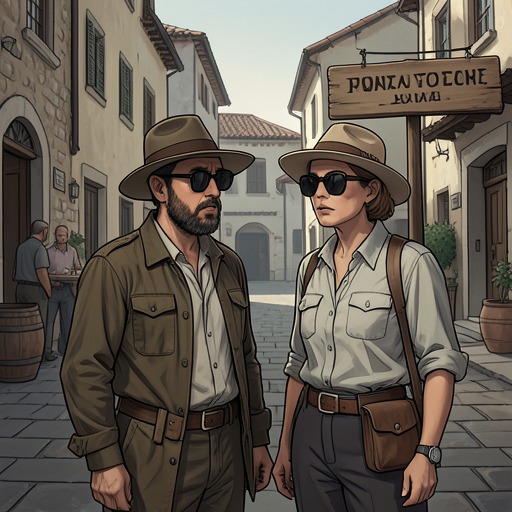
Sylvie and Jean-Luc have assumed that Easter took place in March. When they arrive in the village nearly a month later, they do not recognize that Greek Orthodox Easter falls on a different date from Catholic Easter. Their misunderstanding is practical as well as calendrical: the car-hire company has charged an additional premium for the holiday weekend, but the only person they have spoken to since landing, the car-hire man, did not explain the reason. The couple therefore encounter the holiday first as an unexplained disruption to their expectations.
The closed chemist makes the difference tangible. Sylvie is looking for toothpaste; the shopkeeper rattles her keys to indicate that it is time to leave, and Sylvie asks why everything is so quiet. The answer, delivered in a hiss, is Megali Paraskevi: Good Friday. The shopkeeper gives the name of the day, but no broader explanation. Her abruptness leaves Sylvie and Jean-Luc to piece together the significance from what they see and from the fragments of information they gather afterward.
The Day’s Public Rhythm
At a small taverna near the general store, the owner’s question about whether the couple have booked initially surprises them. The tables are empty, but he explains that people should always reserve at Easter, especially on Good Friday. The apparent contradiction—an empty restaurant on a day when advance booking matters—reflects the fact that the meal is only available within a brief interval in the day’s religious schedule. The couple may have a table for one hour, until the Epitaphios has been carried around the streets and back to the church; after that, the local diners will arrive.
Sylvie and Jean-Luc accept the limited time and sit outside. Their conversation shows them revising their understanding: the full church they noticed is no longer evidence of some unrelated gathering, and the shopkeeper was not making a fool of Sylvie. The day’s quietness is not simply a lack of activity. It belongs to a communal timetable that the visitors had not known to anticipate, and the procession will bring that timetable visibly into the streets.
The Epitaphios Procession
As Sylvie and Jean-Luc finish their meal, a band approaches. Four men carry what looks like a funeral bier, covered with thousands of white flowers; flowers and foliage also adorn the frame. The object is the Epitaphios Jean-Luc had seen in the church. A dozen or so clergy follow, then altar boys and a thirty-strong band playing a doleful funeral march. People in military uniform, sailors, boy scouts, girl guides, and townspeople follow at a slow, dignified pace. A few onlookers throw petals into the road, and the people begin to sing a hymn.
The scene makes the character of Good Friday legible through its details rather than through an explanation of doctrine. The bier, the measured procession, the funeral music, the hymn, and the petals place collective mourning at the center of the day’s public life. For the visitors, the procession joins what had seemed like separate clues—the crowded church, the closed shop, the restaurant’s restricted seating—into a coherent local observance. As the bier passes, Sylvie and Jean-Luc catch the sweet scent of lemon blossom. Sylvie recognizes that this is what the taverna owner meant by the Epitaphios: the religious term has become an event unfolding directly before them.
Good Friday in the Easter Sequence
The couple’s growing grasp of the calendar extends beyond the day itself. Sylvie recounts the sequence she has learned: the image of Christ is paraded around town on Good Friday, Judas is burned in effigy on Saturday, and Sunday celebrates Christ’s resurrection. She also notes the associated meal customs: seafood on Good Friday, a soup made from lamb’s guts on Saturday, and lamb roasted on a spit on Sunday. These details place the procession within a wider sequence of observances, moving from the solemnity of Good Friday toward the celebration of Easter Sunday.
The transition is later made vivid when Sylvie joins the Easter gathering by the waterfront. Fireworks and bangers startle her, but candles are passed from person to person until all one thousand are glowing. A woman gives Sylvie a candle and lights it from her own; the crowd seems happier than it had the previous night. Read alongside the procession, this scene clarifies Good Friday’s place in the holiday’s emotional progression: the restrained, funeral-like movement through town gives way to a shared display of light and celebration. For Sylvie and Jean-Luc, learning the date is therefore more than correcting a calendar error. It is the first step in understanding how the village’s religious observances organize its public spaces, hospitality, and sense of time.